Home » The Banner He Brought Back
The Banner He Brought Back
For three years, the kingdom had lived with a wound it had never truly closed.
The prince was dead.
That was the official truth. That was the truth written into the royal records, spoken in prayer, mourned in black cloth and lowered flags. The prince, the king’s only son, had fallen in battle at the northern frontier while leading men twice his age into a war he should never have had to fight.
The body was never returned.
Only his horse came back.
Bloodied. Riderless. Half-mad with fear.
Then the royal banner was found torn in the mud near the river crossing, and the men who survived swore they had seen the prince surrounded by enemy soldiers before the fog swallowed everything.
It was enough.
Enough for the court to mourn.
Enough for the priests to bless an empty tomb.
Enough for the king to bury his son without a body.
But not enough for him to believe it.
Not fully.
Not in the hours before dawn, when he would wake with the cold certainty that somewhere beyond the borders of his kingdom, his son was still breathing beneath a sky that did not know his name.
The king never spoke of that feeling.
Kings were not supposed to be ruled by instincts they could not prove.
So he wore grief like armor. Silent. Heavy. Permanent.
The court adjusted around it. The laughter in the palace grew quieter. Music in the great hall became rarer. The old warmth that had once softened the king’s face vanished, replaced by a hardness people called wisdom only because they were too afraid to call it sorrow.
Then, on a gray morning wrapped in mist, a rider came through the eastern gate.
At first, the guards barely recognized him.
His armor was cracked and dusty. His cloak was torn nearly to ribbons. Blood—old and dried—darkened one side of his shoulder. The horse beneath him trembled with exhaustion. The man himself looked more ghost than knight.
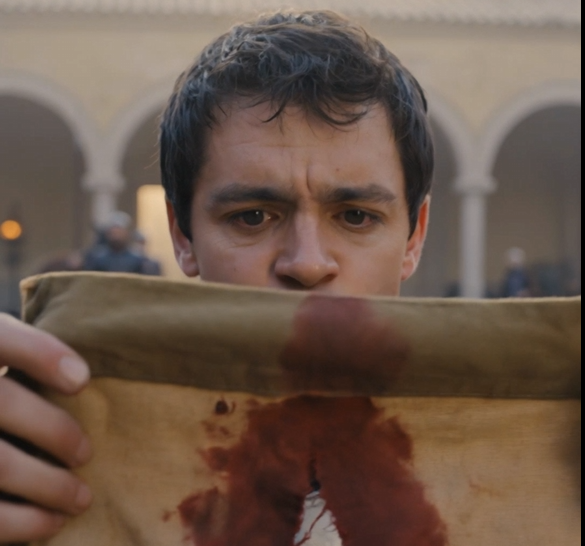
But when he dismounted and fell to one knee in the royal courtyard, clutching a torn royal banner in his hands, the palace stopped around him.
“Your Majesty…” he said, fighting for breath.
“The prince is alive.”
The words spread faster than fire.
Servants stopped moving. Guards turned. Nobles came from shadowed corridors like people drawn unwillingly toward a storm.
And when the king appeared at the top of the stone steps, wrapped in fur and silence, the courtyard seemed to shrink under the weight of his gaze.
“My son died in battle,” he said.
The knight looked up.
This was Sir Aldren—one of the men who had ridden beside the prince on the northern campaign. Loyal. Quiet. Never known for dramatics, which made his presence more dangerous than any loud accusation could have.
“Then why,” Aldren asked, raising the torn banner with trembling hands, “did he give me this… before they took him?”
The king descended the steps himself.